1. Introduction
Agricultural policies and programmes are introduced by the federal, state and local governments in order to ensure availability and accessibility of food at all times and at the long run ensure food security. This is because food is a necessity of life that every individual in a country, irrespective of their income or status, is expected to have access to. Also, it has been regarded as the statutory responsibility of the government to grow and develop its agricultural sector to provide adequate food for its population. The World Health Organisation and the Food and Agriculture Organisation affirmed that Food security can only exist when all the people of a country
Both employed and unemployed have physical, social and economic access to sufficient, safe and nutritious food at all times, which meets their dietary needs and food preferences for an active, healthy life.
Food security, according to a study, is when the people of a country can have access not only in terms of quantity but also quality to all the necessary food nutrients that will enable them to live a healthy and comfortable life
| [2] | O. Fatoki, O., “Implementation of the Skills Acquisition Programme of Youth Empowerment Schemes in Ondo State of Nigeria,” Department of Public Administration, Obafemi Awolowo University, Ile-Ife, Nigeria 4, no. 2 (February 29, 2016): 39–53, https://doi.org/10.31686/IJIER.v4.ISS2.515 |
[2]
. There are traces of food insecurity in all countries of the world, but the situation is said to be worse in most of African countries. This has been attributed to the increase in world population, which has constantly placed a lot of tension on productive lands, thereby causing a reduction in agricultural productions and food to feed the ever-increasing world population
| [3] | S. M. Afu, I. A. Isong, and C. E. Awaogu, “Agricultural Potentials of Flood plain Soils with Contrasting Parent Material in Cross River State, Nigeria,” Global Journal of Pure and Applied Sciences 25, no. 1 (April 29, 2019): 13–22,
https://doi.org/10.4314/GJPAS.V25I1.3 |
[3]
Also, the study stated that there will be more hungry people globally because the world population is increasing at an annual rate of 3.5% while that of food production has been between 1.5% and 2.0%
| [4] | Amaka G Metu, Kenechukwu O Okeyika, and Olisa D Maduka, “Achieving Sustainable Food Security in Nigeria: Challenges and Way Forward,” 2016. |
[4]
. A study also shows that about 33% of the African population, which represent 200 million people, are starving, the continent is said to face a serious problem of hunger in the next two decades unless some viable policies are made to restore peace and ensure good governance in the Sub-Sahara African (SSA) region. This is because about 60% of the countries facing the problem of food insecurity in Africa are the crisis-dominated SSA countries
.
Successive governments in Nigeria, in awareness of the fact that the country is not food secured, have been making efforts to combat the problem through the adoption and implementation of various policies and programmes since the 1970s, but there seems to be no remarkable achievement in this area
| [6] | Metu, Okeyika, & Maduka, “Achieving Sustainable Food Security in Nigeria: Challenges and Way Forward.” |
| [7] | Olu Okotoni, “Governance Crisis and State Failure in Nigeria: Are We All Guilty?,” January 1, 2017,
https://www.academia.edu/67366493/Governance_crisis_and_state_Failure_in_Nigeria_Are_we_all_guilty |
| [8] | “WDR Reports,” accessed June 4, 2025,
https://www.worldbank.org/en/publication/wdr/wdr-archive |
[6-8]
still rely so much on the importation of staple food items and dependency on international organisations for food aid, especially in the crisis-dominated areas of North-Eastern Nigeria. To buttress this, the World Development Indicator in 2016 also revealed that food imports increased from 19.9% in 2000 to 30.6% and 22.7% in 2011 and 2012, respectively, while food exports are barely 5.3% of agricultural produce
| [9] | Jacinta I-Pei Chen., “COVID-19 Containment Measures,” in Uncovering the Science Of COVID-19 (World Scientific, 2023), 147–203. |
[9]
. Also, various studies and statistics have corroborated the argument that Nigeria is not food secure. For instance, FAO, International Fund for Agricultural Development (IFAD) and World Food Programme (WFP) in 2013, revealed that Nigerians have an energy intake of 1730 Kcal and an average protein supply of 64g per capita per day, which is far below the 2500 – 3400Kcal minimum recommended for daily intake.
Food insecurity is one of the present dangers in Nigeria, this was acknowledged in 2013 by the then minister of Agriculture
, Dr. Akinwunmi Adesina that Nigeria still has about 13 million people suffering from hunger and malnutrition. The figure has been proved to be inaccurate by scholars and international statisticians who have rated Nigeria to be one of the countries where hunger and poverty is on the high side. There is hunger both in urban and rural areas, arising from acute shortage of staple food like rice, beans, yam and corn. To World Food Programme, Nigeria is considered a food deficit country and it is the largest importer of rice in Africa as about 1 billion naira is used to import the commodity daily
| [11] | Nathan Marcus, Adamu Friday Joseph, and Donald David, “Studies Management and Finance Economics, of Journal Exploring the Impact of Food Security Strategy and Policy Response on Food Crop Farmers Household Consumption Patterns in Kaduna State, Nigeria,” accessed June 4, 2025,
https://doi.org/10.47191/jefms/v7 |
[11]
Discussing the factors responsible for this opined that climate change, desertification, and unavailability of land, due to the promulgation of the land use decree, where the government claimed ownership of all the lands, Rural-urban drift, increasing population and the oil boom are the reasons why food productions keep declining in Nigeria
| [12] | Romanus Osabohien, Adesola Afolabi, and Abigail Godwin, “An Econometric Analysis of Food Security and Agricultural Credit Facilities in Nigeria,” The Open Agriculture Journal 12, no. 1 (November 5, 2018): 227–39,
https://doi.org/10.2174/1874331501812010227 |
[12]
.
In lieu of the above, the Nigerian Agricultural sector, through the National Agricultural Policy, was reformed with the mandate of enhancing self-sufficiency in food commodities, production and processing of exportable agricultural products to generate revenue for the country as well as feeding the local industries with its agricultural raw material needs among others. To accomplish this mandate, agricultural programmes and policies were introduced at different times. The first of its kind was the programme introduced in the year 1973 by General Yakubu Gowon, the National Accelerated Food Production Programme (NAFPP). This was meant to enhance the production of staple food through the encouragement of subsistent farming across the country. Assessing the performance of the programme, it was described to be a failure as it could not provide the solution to the problem of food shortage in the country
| [13] | Romanus Osabohien et al., “Agriculture Development, Employment Generation and Poverty Reduction in West Africa,” The Open Agriculture Journal 13, no. 1 (July 16, 2019): 82–89, https://doi.org/10.2174/1874331501913010082 |
[13]
In the same vein, the Administration of Murtala/Obasanjo in order to boost local food production and reduce the rate at which staple foods are being imported into the country introduced the Operation Feed the Nation (OFN) programme in May 1976. It was also recorded by study
| [14] | Tim. Denham, José. Iriarte, and Luc. Vrydaghs, “Agriculture, Cultivation and Domestication: Exploring the Conceptual Framework of Early Food Production,” July 1, 2016, 16–35,
https://doi.org/10.4324/9781315421018-2 |
[14]
that the programme did not achieve its objectives as the people even tagged it operation fool the nation.
2. Literature Review
2.1. Conceptual Review
This section reviews the concept of Agriculture, Policy and Public Policy, Food and Food Security.
2.1.1. Agriculture
Agriculture is the art and science of cultivating the soil, growing crops and raising livestock. It comprises preparing plants and animal products for use by people and distributing them to markets. It involves ploughing of land for self or profitable purposes. It involves fishery, forestry, hunting and other activities leading to nature’s possession from the ground
| [15] | The State of Food and Agriculture 2021. Making Agrifood Systems More Resilient to Shocks and Stresses, The State of Food and Agriculture 2021 (Rome: Food and Agriculture Organization of the United Nations, 2021),
https://doi.org/10.4060/cb4476en |
[15]
. Agriculture has been described as a major force all nations of the world identify with to reduce unemployment among youths as well as to boost the economy of the nation
| [16] | Olawale Emmanuel Olayide, Isaac Kow Tetteh, and Labode Popoola, “Differential Impacts of Rainfall and Irrigation on Agricultural Production in Nigeria: Any Lessons for Climate-Smart Agriculture?,” Agricultural Water Management 178 (December 1, 2016): 30–36,
https://doi.org/10.1016/j.agwat.2016.08.034 |
[16]
. It is the process of cultivating land and rearing animals for the consumption of mankind
.
Agriculture is the science, practice and occupation of cultivating the land and raising livestock for the purpose of consumption, commercialization and also generating employment for the generality of the people of a country
| [18] | Aderibigbe S Olomola and Maryam Yaro, “Commercial Banks’ Response to Government’s Financial Stimulus for Improved Agricultural Financing in Nigeria,” Abuja: International Food Policy Research Institute (IFPRI). National Strategy Support Programme II Working Paper 28 (2015): 15738coll2. |
[18]
. The people of a country engage in agricultural practices in order to provide food and livestock for the consumption of their immediate family. In the same vein, they engage in agricultural businesses to generate revenue for themselves by selling their various agricultural produce to industries or factories that need them in order to get other goods and services they are in need of. In line with the above definition, Agricdemy defined agriculture as the science or practice of cultivating the land and keeping or rearing of animals for animal for food
| [19] | Abiola John Asaleye, Joseph Olufemi Ogunjobi, and Omotola Adedoyin Ezenwoke, “Trade Openness Channels and Labour Market Performance: Evidence from Nigeria,” International Journal of Social Economics 48, no. 11 (2021): 1589–1607. |
[19]
. From this definition by Agricdemy, one can easily conclude that there are two aspects or branches of agriculture, the first branch is the growing of plants or crops, while the second aspect is the breeding, keeping or rearing of animals for food. The first aspect, which involves the cultivation of land (crops/plants) is known as agronomy, and the second branch, which is the breeding of animals, is referred to as animal husbandry. Agriculture helps in reducing the cost spent on the consumption of food, it also helps in curtailing the level of migration from rural areas to the urban areas, this is so because most agricultural activities take place in the rural areas and it helps to provide healthy food for human consumption.
In agreement with the view of a study, it was revealed of the opinion that agriculture is one of the major channels through which a country can achieve national development and growth because it is a profession that is readily available for people to venture into
| [20] | Romane Viennet and Beatriz Pont, “Education Policy Implementation: A Literature Review and Proposed Framework,” 2017. |
[20]
. If many people are engaged in agriculture, especially the mechanized type of agriculture, the government can reduce the importation of certain food commodities by encouraging the domestic cultivation of crops like rice.
Agriculture in Nigeria is made up of four sub-activities and they are crop production, livestock, forestry and fishing. While the Nigerian economy is heavily dependent on oil, agriculture still contributes a significant amount to the Nigeria’s economy, but it is greatly believed by people that the sector can contribute more to the economy than it’s doing presently
| [21] | Michael Hill and Frédéric Varone, The Public Policy Process (Routledge, 2021). |
[21]
. It has also been recognized by successive governments especially that of the past administration of Goodluck Jonathan and the present administration of Muhammadu Buhari, that if Nigeria is to be developed, its economy must be diversified from oil and there must be a refocus on agriculture. According to the Central Intelligence Agency (CIA), agriculture contributes 40% of the GDP and employs about 70% of the Nigerian workforce
| [22] | Ernest Jebolise CHUKWUKA and IMIDE Israel Onokero, “Strategic Role of Policy Formulation and Implementation on National Economic Development of Nigeria: An Entrepreneurial Policy Approach,” World 2579 (2024): 544. |
[22]
. In the rural areas where about 50% of the Nigerian population resides, agriculture is said to be the main economic activity.
2.1.2. Policy
Policies are decisions that are made for the purpose of implementing programmes in order to achieve a desired goal or objective
| [23] | Azad Singh Bali et al., “Procedural Policy Tools in Theory and Practice,” Policy and Society (Oxford University Press, 2021). |
[23]
. A study opined that a policy is what government or organisations do, why they do it and what difference it makes
| [24] | Ben Enserink, Pieter Bots, and Els van Daalen, “Policy Analysis of Multi-Actor System,” 2022. |
[24]
. The concept of policy can be used in both the private and public sectors of a society. A policy that is made by an individual or private organisation is referred to as a private policy, while those made by the government and its ministries, departments and agencies are called public policies. The term policy has different meanings depending on the perspective from which one views it. To some scholars, a policy is considered an action; to some others, it is a choice, while it is also described in terms of the scope of an action. Policy was defined as a course-setting action that provides guidance and direction on how the goals and objectives that have been defined by stakeholders will be achieved
| [25] | Sandeep Vij, Ritika Sharma, and Nisha Kainth, “Case Studies of Corporate Misconduct and Failures: Major Learnings and Indian Response,” n.d. |
[25]
.
Policy is a guiding tool of any organisation. It is seen as a guiding rule and procedure upon which the actions and activities of actors in particular issues or problems are guided. Policy is a major guideline for action. It provides a template that a course of action will follow
| [26] | Nicholas Henry, Public Administration and Public Affairs (Routledge, 2015). |
[26]
. This definition also discusses the key characteristics of a policy to include the fact that it involves decision-making. These characteristics explain the fact that before policies are made, important choices or decision must have been made by individuals, groups, organizations or government. It also connotes that there are various policy options from which a policy maker chooses from. Secondly, a policy is said to be a proposed course of action or projected set of decisions. This explains that a policy is futuristic. It states what will be done and what will not be done by an individual or organisation. Another characteristic of policy is that it is always goal-oriented. Every policy has a particular objective or goal that it wants to achieve. Fourthly, every policy has to do with solving societal problems. A policy is always a response to a particular demand of people in an organisation or society. It is when the policymaker wants to solve a problem or meet the needs of the people in a group that they formulate a policy. Finally, a policy is a course-setting action. It provides a guide, direction or focus on how a goal will be attained
| [27] | Christoph Knill and Jale Tosun, Public Policy: A New Introduction (Bloomsbury Publishing, 2020). |
[27]
.
2.1.3. Public Policy
Public policy is one of the fundamental tools in the hands of government used in providing its citizens with the desired social amenities as well as ensuring their well-being. This is why the concept has gained attention from the people in academia, politics and the field of public policy analysis. Many people have attempted to define public policy; it was described public policy to be the relationship a government has with its environment
| [28] | Elliot M Berry et al., “Food Security and Sustainability: Can One Exist without the Other?,” Public Health Nutrition 18, no. 13 (2015): 2293–2302. |
[28]
. Looking at this definition, it explains public policy to be the extent to which a government is aware of what is going on within the State it governs and how responsive the government is to the needs of the environment and the people. A study offers another dimension to what public policy is all about a course of action adopted and pursued by the government of a state.
| [29] | Francesco Burchi and Pasquale De Muro, “From Food Availability to Nutritional Capabilities: Advancing Food Security Analysis,” Food Policy 60 (2016): 10–19. |
[29]
This is to say that public policy is a project or programme that the government believes will be capable of solving a social problem and therefore, it is committed to the attainment of the goals of such policies.
In summary, public policy is actions of government directed at providing the needs of the public for the betterment of society and also at ensuring the continued existence of government in gaining public loyalty. The key element of public policy is that it is an output of governmental actions undertaken by governmental officials or authorities. Public policies are constantly changing as they are shaped and reshaped, modified and changed and sometimes rejected for new policies
| [30] | Emmanuel Ogueri Ibekwe, “POLITICS OF FOOD SECURITY AND SOCIAL CHANGE IN NIGERIA,” African Journal of Social and Behavioural Sciences 14, no. 6 (2024). |
[30]
When excellent policies are made by the government, it translates into an excellent country.
2.2. Food and Food Security
Before attempting to conceptualize food security, this study would first like to define what food is. Food is said to be the most basic and essential need of the human race and this is because of its centrality to human existence. Everybody needs food to survive
| [31] | Shashi B Sharma and John A Wightman, “Vision Infinity for Food Security: Some Whys, Why Nots and Hows!” (Springer, 2015). |
[31]
, this is defining and explaining the importance of food states that.
“Food is the fuel that energizes the body for effective routine performance and the lack of food makes an individual lethargic, indolent, cheeky and haughty. Unfortunately, the important and pivotal advantages of food to life and to a country’s economy have been terribly downplayed, especially in developing nations. These developing economies, including Nigeria, will be extremely affected if painstaking and pragmatic efforts aren’t immediately embarked upon. This would in no small measure hamper food security”
This statement clearly spells out the importance of food, it must be available to the people to an extent that will meet some acceptable level of nutritional standards in terms of calories, protein and minerals which the body needs.
Food security is one of the key targets of the Millennium Development Goals (MDGs) and Sustainable Development Goals (SDGs), in which Nigeria as a country has greatly adopted and is trying to see that the goals are achieved in the country. In the same vein, one of the goals of the Nigerian agricultural policy is to ensure that Nigeria produces enough food for its population, as well as reduce the rate at which the country imports staple food from other countries of the world.
Food security can be said to mean access by all the people of a society at all times to adequate food, which is required for an active, healthy life
| [32] | M. Ake et al., “Feminization, Food Security, and Hunger Eradication: A Case of Omu-Aran Community in Kwara State, Nigeria,” IOP Conference Series: Earth and Environmental Science 445, no. 1 (2020),
https://doi.org/10.1088/1755-1315/445/1/012047 |
[32]
The central elements of food security are the availability of food for the people, irrespective of their status in the society and the possession of the ability its acquire it
. This simply means, before a country can be said to be food secured, her people must have the ability (financial resources) to possess the sufficient quantity and quality food required for them to live a decent life. According to World Health Organization (WHO) and FAO; food security is access to the food needed by all people to enable them to always live a healthy life
| [34] | Oreoluwa Ibukun Akano, Folasade Olubunmi Oderinde, and Abiodun Olusola Omotayo, “Agricultural Yield, Food Nutrition and Dietary Energy Supply in Nigeria: Evidence from Nationally Representative Data,” Journal of Agriculture and Food Research 11 (2023): 100525. |
[34]
. A food-secured situation is said to exist when the demand side for food is balanced with the supply side of food; anything contrary to this suggests food insecurity
| [35] | World Health Organization, The State of Food Security and Nutrition in the World 2018: Building Climate Resilience for Food Security and Nutrition (Food & Agriculture Org., 2018). |
[35]
.
The issue of food insecurity is one of the problems government all over the world as well as international organisations such as Food and Agricultural Organisation (FAO), World Food Programme (WFP) etc. are contending with since 1974 during the World Food Conference when it became very obvious that countries of the world need to plan on how to improve agricultural productions so as to meet the food demands of the ever growing population of the world
| [36] | T O Osuolale, S A Ogunrinade, and B A Shittu, “Food Insecurity in Nigerian Society ‘The Result of Social-Political Conflict’” 6, no. 6 (2016), www.iiste.org |
[36]
. The World Food Summit held in Rome in the year 2009 declared that about six million children die of hunger every year, 17,000 die of starvation every day and it was also presumed that by 2050, the world will have an additionally two million mouths to feed
| [31] | Shashi B Sharma and John A Wightman, “Vision Infinity for Food Security: Some Whys, Why Nots and Hows!” (Springer, 2015). |
[31]
These statements are to re-awaken the consciousness of the people and government of countries that a lot of things must be done in order to ensure food security worldwide.
Nigeria is a country blessed with enough natural and human resources. It has many arable lands which are yet to be cultivated by people for agricultural purposes. Despite this blessing, the majority of Nigerians are still living below the poverty line
| [6] | Metu, Okeyika, & Maduka, “Achieving Sustainable Food Security in Nigeria: Challenges and Way Forward.” |
[6]
. According to the World Development Index (2015), more than 60% of the population of Nigeria live on less than US$1.25 per day. Also, Nigeria has been declared one of the countries (91 out of 104) in the world where its citizens are most vulnerable to hunger and malnutrition (Human Development Index (HDI)
| [32] | M. Ake et al., “Feminization, Food Security, and Hunger Eradication: A Case of Omu-Aran Community in Kwara State, Nigeria,” IOP Conference Series: Earth and Environmental Science 445, no. 1 (2020),
https://doi.org/10.1088/1755-1315/445/1/012047 |
[32]
. Consequently, any country that relies on food hand out or aids before her citizens can eat is only proffering a short term solution to its food problems and will find it hard to attain the status of food security because the people will have food to eat only when the external bodies that supplies them are willing and able to supply. Also, massive food import, particularly by developing countries, usually has a negative effect on their foreign reserves, making them dependent and causing budgetary haemorrhage, just like the case of Nigeria, which is regarded as the largest importer of rice in Africa. Even though the government are making concerted efforts within the agricultural sector to stop the importation of staple foods, what we have at the moment, in terms of agricultural produce, cannot feed the teeming Nigerian population.
According to the World Bank, food security revolves around 3 pillars, which are food availability, food accessibility and nutrition factors. Analysing these pillars opined that food availability is when there are different kinds of quality surplus foods in a country available for the people to consume. Food access on the other hand means alleviating poverty among the people by providing them with various social, empowerment and welfare programmes thereby increasing their purchasing powers
.
The review of extant literatures revealed that food security is a global issue and many countries, developed and developing ones are struggling to be food secured. Scholars who have written on food security are of the opinion that world leaders recognized the problem of food shortage and insecurity and all acknowledged the fact that the problem must be dealt with as soon as possible before it worsens.
2.3. Theoretical Framework
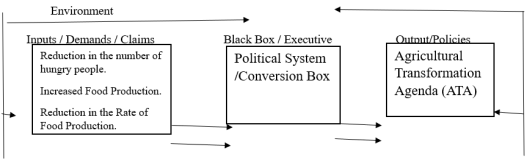
The study is anchored on the systems theory. This was because it is the most suitable theory out of the reviewed theories that can adequately explain and analyse this study because of its input and output analytical approach. The concept of systems theory is very germane and instructive in the process of public policy making, implementation and evaluation. Almost every process of making agricultural policies and programmes can be divided into INPUT, PROCESS and OUTPUT; same is applicable in public administration as the systems approach to the study of public administration revealed. Part of the functions of government is to ensure the country is food secured by providing an enabling environment that will make food production to increase in its entirety.
This has been discovered to be within the purview of the study of public administration and the various strategies of achieving food security embedded in the various agricultural programmes like ATA, farmers’ empowerment, and the land use decrees are also of public administration concern. Therefore, a study of Agricultural policies (Agricultural Transformation Agenda) and food security in Nigeria should be studied with the systems approach. This section of the work will then explain this study using the input, processing and output analysis. In this regard, the Nigerian government stands as the political system while the society which comprises the people and other institutions stands as the environment.
Inputs: These are human and material factors such as personnel, fertilizers, micro finance credit, pesticides etc. supplied to the system which are transformed into productive services or programmes. As an open system, the government utilizes inputs in the form of claims and demands made by individuals, groups (in this case, people who are hungry, farmers, agricultural extension workers, etc.) or communities for actions to satisfy their interest while support is rendered when individuals or communities pay their taxes, rates, licenses, obey the laws and the staff contribute their best in administering the social services, welfare packages and benefits. Demands such as training for farmers, supply of seedlings, credits to procure farm tools, fertilizers, pesticides, machines, agricultural education etc. are made by the people, farmers, and stakeholders in the agricultural sector of the government.
Conversion Process: The inputs from the environment into the political system (demand for increased food items, farmers’ empowerment and trainings, job creation) must be processed and converted into outputs which are often called policies and programmes. This stage is called the conversion process and it is the process by which inputs are changed into output and is referred to as transformation. In Nigeria, inputs like public funds, fertilizers, natural resources like land and various categories of staff are utilized to provide required food items, dietary needs of the people, raw materials for industries and services such as trainings for the farmers, credit facilities, and employment opportunities for the general development of the people. Also, staff of the Ministry of Agriculture and Rural Development at the federal and state levels are always utilized in this process. Also included are the National Assembly and all other governmental arms and agencies within the agricultural sector.
Output: The services, policies and programmes which the government sent out to the people as end product is known as output. In this case, the governmental outputs includes most specifically, the policies and programmes of government such as the Agricultural Transformation Agenda (ATA) Programme, National Food Crisis Response Programme (NFCRP), National Food Security Response Programme (NFSRP), introduced to quell food insecurity, low agricultural productions and other conditions put in place to cushion the ill-effects of food insecurity like food importation and distribution of food items to people of the country among others.
The systems approach requires that when public administrators plan, they have no choice but to consider environmental factors like political, social, economic and ethical issues of the society on the target group. In other words, it requires interdependence of elements which signifies that various sector of a country depends on one another to survive or function appropriately. This concept of inter dependence of elements is one of the concepts of the systems theory that also deserves some attention in the course of using the systems theory to explain or analyze the present study.
Interdependence of Parts: The inter-working relationship between the parts of the system and the whole system shows interdependency. This means that when a part of the system is affected in the course of any action, it affects other parts. For instance, the various ministries such as the Ministry of Agriculture, Water Resources, Rural Development, Labour, Education, Finance, Internal affairs as well as the Legislature are all interrelated because they all have the mandate of ensuring political, social and economic growth and development of the people and the country at large.
The Systems theory offers a fruitful approach to this study because of its input-output conversion mode. Input in form of demands and support are received from the environment and output in form of programmes, policies and laws which brings about changes in the environment are also injected back into the system thereafter. This theory helps us in understanding how the Agricultural Transformation Agenda (ATA) as well as other agricultural policies and programmes are been made and implemented through the input, conversion processes and output analysis of the systems theory as the theory is generally used in analyzing policy processes in public administration.
Figure 1. A Model Representing the Processes of Making Agricultural Programmes.
Figure 1 is a model representing how agricultural policies/programmes are formulated in Nigeria using the input and output analysis model. As discussed under the theoretical framework, inputs or demands or claims are coming from the environment which consist of people and various groups. These demands are always in form of people yearning for the reduction in number of hungry people, increased food production, reduction in the price of food, rate of food importation, elimination of malnutrition, training of farmers and attainment of food security. These demands or claims have always been channeled into the political system and the system processes the demands from the environment and in turn formulate agricultural policies like the ATA which are been injected into the environment to address the problems facing the people as regards food and agriculture. These policies or programmes are referred to as outputs which is the Agricultural Transformation Agenda (ATA).
From the literatures and studies reviewed so far in the area of agricultural policies and food security, there seems to be a general agreement among scholars that the attainment of food security in any country is very paramount and essential in the pursuit of her developmental goals. The various causes of food insecurity, rate of food insecurity and challenges militating against the attainment of food insecurity have been researched into by many scholars and most of them were of the opinion that the food situation in Nigeria is very worrisome. Also, many scholars have written a lot about the efforts of governments in combating food insecurity in Nigeria through the formulation and adoption of various policies and programmes since 1970s.
4. Data Analysis and Discussion
4.1. Sociol-demographic Features of Respondents
Table 1 shows the demographic information of the respondents sampled in this study. On the table, 159 (58.0%) of the respondents were male, while 111 (40.5%) of the respondents were female. The significance of this is that both the male and female genders were well represented in carrying out this study. Thus, the responses cannot be said to be biased based on respondents’ gender. The table further shows the states of the respondents. On the table, 62 (22.6%) of the respondents were from Kwara State, 60 (21.9%) of the respondents were from Plateau State, 55 (20.1%) of the respondents were from Oyo State, 43 (15.7%) of the respondents were from Osun State, 36 (13.1%) of the respondents were from Delta State, while 18 (6.6%) of the respondents were from Edo State. This implies that the study cut across all the regions in Nigeria, and the results gotten from this study could be generalized on the whole country.
The table also shows the age distributions of the respondents. On the table, 104 (38.0%) were between the ages of 41 and 50 years, 78 (28.5%) were between the ages of 31 and 40 years, 61 (22.3%) of the respondents were between 51 years of age and above, 22 (8.0%) were between the ages of 21 and 30 years, while 03 (1.1%) were between 20 years old and below. From this age distribution, it can be concluded that the respondents cut across the legally working age (18 years and above) in Nigeria. Thus, the responses from this study cannot be said to be biased in terms of respondents’ ages. Also, this table further shows the marital status of the respondents in this study. 209 (76.3%) of the respondents were married, 34 (12.4%) of the respondents were single, 16 (5.8%) of the respondents were divorced, 13 (4.7%) of the respondents were widows. This also implies that the respondents cut across the diverse marital status needed for this study. This table also presented the religion of the respondents. On the table, 157 (57.3%) of the respondents were Christians, 97 (35.4%) of the respondents were Muslims, while 13 (4.7%) of the respondents were traditional worshippers.
The significance of this is that responses from the respondents sampled in this study were sincere and represents the true state of the research being carried out. This is because these religions teach sincerity on the parts of their worshippers. The educational background of the respondents were also represented in this table, 118 (43.1%) of the respondents had BSC/HND degrees, 48 (17.5%) of the respondents had OND/DIP degrees and MPA/MBA/M.A/M.Sc degrees respectively. 21 (7.7%) of the respondents possessed WASSCE/SSCE/GCE and Primary school leaving certificate. 09 (3.3%) of the respondents possessed Ph.D degree. This implies that all the respondents in this study had some level of education, and that the respondents were well informed in their decisions and responses to this study. Thus, it can be said that responses from this respondent could be considered true and accurate.
The table finally shows the categories of the respondents for this study. 94 (34.3%) of the respondents were Local Government staff, 81 (29.6%) of the respondents were State Government staff, 65 (23.7%) of the respondents were farmers, while 21 (7.7%) of the respondents were Federal Government staff. From this, it can be concluded that all the necessary respondents who could provide information on ATA were well represented in this study. Thus, the sources of the information were right, accurate and appropriate.
Table 1. Demographic Information of the Respondents.
Variables | Frequency | Percent |
Sex | Male | 159 | 58.0 |
Female | 111 | 40.5 |
No Response | 04 | 1.5 |
Total | 274 | 100.0 |
State | Delta | 36 | 13.1 |
Edo | 18 | 6.6 |
Kwara | 62 | 22.6 |
Osun | 43 | 15.7 |
Oyo | 55 | 20.1 |
Plateau | 60 | 21.9 |
Total | 274 | 100.0 |
Age | Below 20 | 03 | 1.1 |
21-30 | 22 | 8.0 |
31-40 | 78 | 28.5 |
41-50 | 104 | 38.0 |
51 and above | 61 | 22.3 |
No Response | 06 | 2.2 |
Total | 274 | 100.0 |
Marital Status | Single | 34 | 12.4 |
Married | 209 | 76.3 |
Divorce | 16 | 5.8 |
Widow | 13 | 4.7 |
No Response | 02 | 0.7 |
Total | 274 | 100.0 |
Religion | Christianity | 157 | 57.3 |
Islam | 97 | 35.4 |
Trad | 13 | 4.7 |
No Response | 07 | 2.6 |
Total | 274 | 100.0 |
Educational Background | PSLC | 21 | 7.7 |
WASSCE/SSCE/GCE | 21 | 7.7 |
OND/DIP | 48 | 17.5 |
BSC/HND | 118 | 43.1 |
MPA/MBA/M.A/M.Sc | 48 | 17.5 |
Ph.D | 09 | 3.3 |
No Response | 09 | 3.3 |
Total | 274 | 100.0 |
Categories | Federal Govt Staff | 21 | 7.7 |
State Govt Staff | 81 | 29.6 |
Local Govt Staff | 94 | 34.3 |
Farmer | 65 | 23.7 |
No Response | 13 | 4.7 |
Total | 274 | 100.0 |
Source: Field Survey, 2024
4.2. Examination of the Strategies Put in Place to Implement the ATA in Nigeria
Table 2 presents the strategies put in place to implement the Agricultural Transformation Agenda (ATA) in Nigeria. On the table, the “Federal Ministry of Agriculture and Rural Development (FMARD) being the lead team saddled with the responsibility of implementing the ATA in Nigeria since inception” as 231 (84.3%) respondents strongly agreed and agreed with this, while the item also ranked as 1st, with RII 0.838. This was followed by “the expectations of the States’ Ministries of Agriculture to incorporate the national policy and programmes into theirs for the purpose of nation-wide implementation” as 235 (85.7%) of the respondents both strongly agree and agree with this, which also ranked as 2nd among the items with RII 0.812. Also, “The Department of Agriculture and Food Security at the local government level are saddled with the responsibility of working with the lead team to implement the ATA in order to ensure food security at the local levels in Nigeria” ranked as 3rd, as 193 (74.4%) of the respondents both strongly agreed and agreed with this.
The implication of this is that Agricultural Transformation Agenda is a programme well known in Nigeria, right from the federal, state and ministry levels of government in the country. The result further showed that building of storage facilities like silos ranked as the 4th strategies, as 180 (65.7%) respondents both strongly agreed and agreed with this, however, these facilities were noted to be inadequate in different parts of the local government communities all over the country to store excess food since the ATA is targeted to increase food productions.
Also, information about ATA to farmers, their associations or cooperative societies at the local areas was moderate as 157 (57.3%) of the respondents strongly agreed and agreed with this, while 112 (40.9%) of the respondents strongly disagreed and disagreed. This item also ranked as 5th, with RII 0.671. This implies that even though the programme is well known at the federal, state and local government levels, information on the programme to local farmers and other stakeholders especially at the local level has not been adequately provided. Whereas, methods of coordination and supervision of the programmes could not be said to be adequately designed as 147 (61.0%) agreed, while 104 (38%) respondents disagreed with the fact that there was adequate coordination and supervision of the programme. This item also ranked as 6th, with RII 0.660.
The results also showed that capacity development for both public and private partners for the purpose of the implementation of ATA were not widely embarked on, as 158 (57.2%) respondents strongly agreed and agreed, while 116 (42.3%) strongly disagreed and disagreed with this fact. Also, this item ranked as 7th, with RII 0.655. Also, the supports of other government ministries and agencies such as Ministries of Environment, Water Resources, Finance, Budget Office, Central Bank of Nigeria, Agricultural Development Bank were not adequate, as 151 (55.1%) respondents agreed with this, while 122 (44.5%) of the respondents both strongly disagreed and disagreed. This implies that the efforts of other public and private agencies in the implementation of ATA was not adequate.
The least of the strategies include efforts by the African Development Bank in providing funds for ATA implementation which 114 (41.6%) of the respondents opined that ADB provides no funds for the programme. This item also ranked as 12th with RII 0.588. While 158 (57.7%) of the respondents strongly disagreed and also disagreed that “Rehabilitation of agricultural and ancillary social infrastructure which include irrigation water conveyance canals were embarked upon”. This item also ranked as 13th, with RII 0.585. Therefore, from this result, it can be concluded that Agricultural Transformation Agenda (ATA) is a programme well known in Nigeria, at the federal, state and local government areas, however, coordination and information about the programme at the state and local levels are lacking, while appropriate strategies to implement Agricultural Transformation Agenda (ATA) were not put in place at the Federal, State and Local government levels.
Table 2. Strategies put in place to implement the Agricultural Transformation Agenda (ATA) in Nigeria.
S/N | ITEMS | 4 | 3 | 2 | 1 | RII | Rank |
1. | The Federal Ministry of Agriculture and Rural Development (FMARD) has been the lead team saddled with the responsibility of implementing the ATA in Nigeria since inception | 161 (58.8) | 70 (25.5) | 22 (8.0) | 20 (7.3) | 0.838 | 1 |
2. | The various States’ Ministries of Agriculture are also expected to incorporate the national policy and programmes into theirs for the purpose of nation-wide implementation | 125 (45.6) | 110 (40.1) | 21 (7.7) | 18 (6.6) | 0.812 | 2 |
3. | Crop processing sites were constructed in all states to ensure proper implementation of ATA | 27 (9.9) | 112 (40.9) | 93 (33.9) | 33 (12.0) | 0.605 | 10 |
4. | The Department of Agriculture and Food Security at the local government level are saddled with the responsibility of working with the lead team to implement the ATA in order to ensure food security at the local levels in Nigeria | 50 (18.2) | 143 (52.2) | 50 (18.2) | 31 (11.3) | 0.693 | 3 |
5. | The Farmers, their Associations or Cooperative Societies at the local areas are informed of the existence of ATA | 66 (24.1) | 91 (33.2) | 86 (31.4) | 26 (9.5) | 0.671 | 5 |
6. | The African Development Bank which is a partner of the federal government in implementing the ATA does not provide the funds needed for the implementation of the programme as at when due | 35 (12.8) | 79 (28.8) | 107 (39.1) | 53 (19.3) | 0.588 | 12 |
7. | Agricultural Transformation Implementation Council provide oversight functions as at when due | 27 (9.9) | 102 (37.2) | 114 (41.5) | 26 (9.5) | 0.609 | 9 |
8. | Methods for coordination and supervision of programmes were adequately designed | 43 (15.7) | 124 (45.3) | 75 (27.4) | 29 (10.6) | 0.660 | 6 |
9. | Storage facilities like silos and others have been built but not adequate in different parts of the local government communities all over the country to store excess food since the ATA is targeted to increase food productions | 64 (23.4) | 116 (42.3) | 53 (19.3) | 41 (15.0) | 0.685 | 4 |
10. | Agricultural Transformation Implementation Council is adequately staffed with all relevant personnel like program coordinator, civil and irrigation engineers, procurement officers among others | 28 (10.2) | 84 (30.7) | 122 (44.5) | 40 (14.6) | 0.591 | 11 |
11. | Other Supporting government Ministries and agencies like Environment, Water Resources, Finance, Budget Office, Central Bank of Nigeria, Agricultural Development Bank provides the necessary support needed to implement the ATA in order to ensure food security | 31 (11.3) | 120 (43.8) | 91 (33.2) | 31 (11.3) | 0.636 | 8 |
12. | Rehabilitation of agricultural and ancillary social infrastructure which include irrigation water conveyance canals were embarked upon | 18 (6.6) | 96 (35.0) | 123 (44.9) | 35 (12.8) | 0.585 | 13 |
13. | Capacity development for public and private partners were also embarked upon in order to implement ATA | 45 (16.4) | 113 (41.2) | 83 (30.3) | 33 (12.0) | 0.655 | 7 |
Source: Field Survey, 2024
Furthermore, attempt was made to analyze the adequacy of the strategies put in place for the implementation of Agricultural Transformation Agenda (ATA). To achieve this, responses of the respondents were summed together to constitute respondents’ measure on Agricultural Transformation Agenda (ATA) implementation strategies. On the measure, the mean score was 34.5, the Standard Deviation was 7.28, and the minimum and maximum were 13 and 49 respectively. On the measure, scores between 40 and below were regarded as inadequate implementation strategy, while scores above 40 were regarded as adequate implementation strategy. These were subjected to descriptive analysis and the result is presented in
Table 2.
Table 3. Adequacy of the strategies put in place to implement the Agricultural Transformation Agenda (ATA) in Nigeria.
| Frequency | Percent |
Inadequate | 213 | 77.7 |
Adequate | 61 | 22.3 |
Total | 274 | 100.0 |
Source: Field Survey, 2024
Table 3 presents the adequacy of the strategies put in place for the implementation of Agricultural Transformation Agenda (ATA) in Nigeria. On the table, majority of the respondents (77.7%) opined that the strategies are inadequate, while 22.3% of the respondents agreed that the strategies are adequate. From this, it can be concluded that the strategies put in place for the implementation of Agricultural Transformation Agenda (ATA) in Nigeria was largely inadequate.
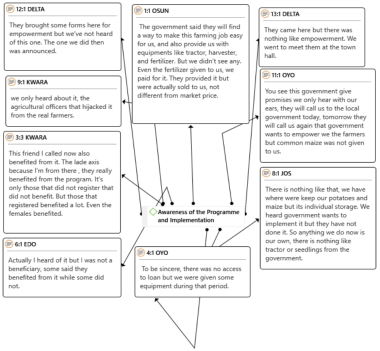
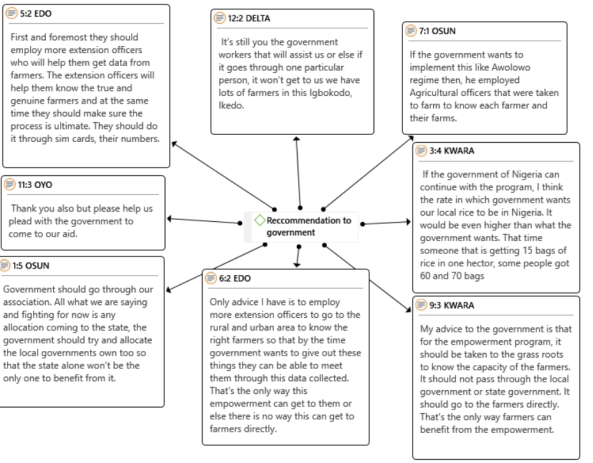
To complement the data gathered through the administration of questionnaires to different stakeholders as regards the implementation strategies put in place to implement the ATA, interviews were also conducted on farmers and some strategic people that can provide us with necessary information as regards the adequacy of the strategies adopted to implement the programme. The responses were analysed using content analysis and diagrams through Atlas.ti package.
One of the interviewees was able to disclose that the strategies were adequate in some states of the federation because the State government gave the necessary support needed by the implementing agencies to record success while some states failed to support the implementing agencies, hence, the strategies could work effectively to achieve the policy goals of ATA. Findings also revealed that, politics was a factor in the process of distributing fertilizers, insecticides, seedlings and other materials and facilities that come with the programme. The political parties in power at the State level were a factor that determines if the State will be reckoned with or not in the course of disbursing funds and other benefits.
Figure 2. A Model Representing Farmers Opinion about the Awareness and Adequacy of the Strategies Adopted to Implement ATA.
Table 4. Adequacy of implementation strategies of ATA on Food security.
ATA Strategies | Food Security | Total | Value | df | Sig. |
Low | High |
Inadequate | 192 (70.1%) | 21 (7.7%) | 213 (77.7%) | 24.615a | 1 | 0.000 |
Adequate | 39 (14.2%) | 22 (8.0%) | 61 (22.3%) |
Total | 231 (84.3%) | 43 (15.7%) | 274 (100.0%) |
Source: Field Survey, 2024
Table 4. presents the adequacy of the implementation strategies of ATA on food security in Nigeria. On the table, the results showed that there is high level of inadequacy of ATA implementation strategies, whereas, the inadequacy level also led to low level of food security in Nigeria. This relationship was found to be significant, as the p < 0.05 acceptable level of significance. Therefore, it can be concluded that the low level of ATA implementation strategies leads to a low level of food security in Nigeria.
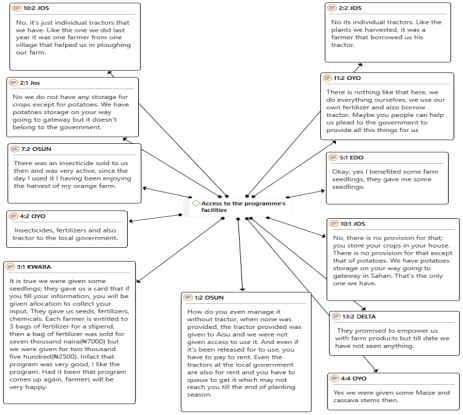
To complement the data gathered through the administration of questionnaire to different stakeholders as regards the implementation strategies put in place to implement the ATA, interviews were also conducted with farmers and some strategic people that can provide us with necessary information as regards the adequacy of the strategies adopted to implement the programme. The responses were analysed using content analysis and diagrams. One of the interviewees was able to disclose that the strategies were adequate in some states of the federation because the State government gave the necessary support needed by the implementing agencies to record success while some states failed to support the implementing agencies, hence, the strategies could work effectively to achieve the policy goals of ATA.
Figure 3. Access to programme Facilities.





 Share This Article
 Twitter
 Linked In
 Facebook
 Copy
Copy Download